
Net-zero by 2040 – at the latest
Towards net-zero by 2040
Sweco’s Group-wide climate target is to achieve net-zero carbon emissions by 2040 and halve the company’s emissions by 2030. The path to achieving this is based on country-specific targets, with each business area formulating a roadmap and climate transition plan.
Sweco’s operations are comprised of consultancy services enabling clients with the climate transition in areas including energy, industry, resource use and transportations infrastructure. Sweco’s targets and emissions reporting are limited to the environmental and climate impact that occurs upstream in the value chain (suppliers), as well as in our own operations. Impact from advisory and consulting services in projects is part of Sweco’s downstream chain (clients) and is not included in current climate targets and emissions reductions.
Climate targets based on the latest science
Sweco adheres to the “Business Ambition for 1.5°C” and has set climate targets aligned with what is required to limit global warming to 1.5°C. In 2024, the Science Based Targets initiative (SBTi) validated and approved Sweco’s near-term targets for 2030. Targets cover Scope 1, 2 and 3 greenhouse gas (GHG) emissions and are well in line with the latest science and the Carbon Law.
Sweco follows the Carbon Law, developed by the Stockholm Resilience Centre, which involves halving the company’s emissions every decade. The near-term targets are consistent with the Carbon Law and halving total emissions by 2030.

Sweco’s SBTi-approved targets
Scope 1&2 target
90 %
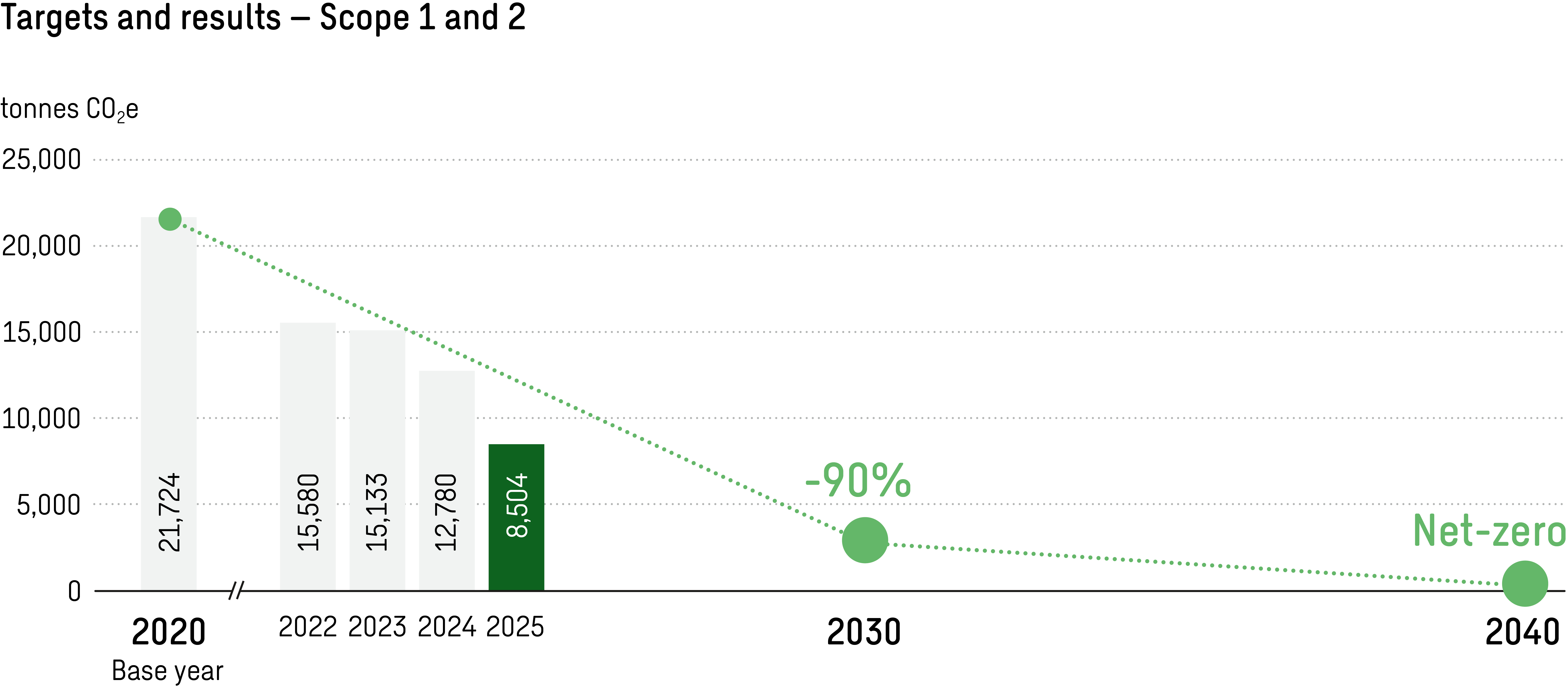
Sweco commits to reduce absolute Scope 1 and 2 GHG emisisons by 90 per cent by 2030 from a 2020 base year.
Scope 3 target
30 %
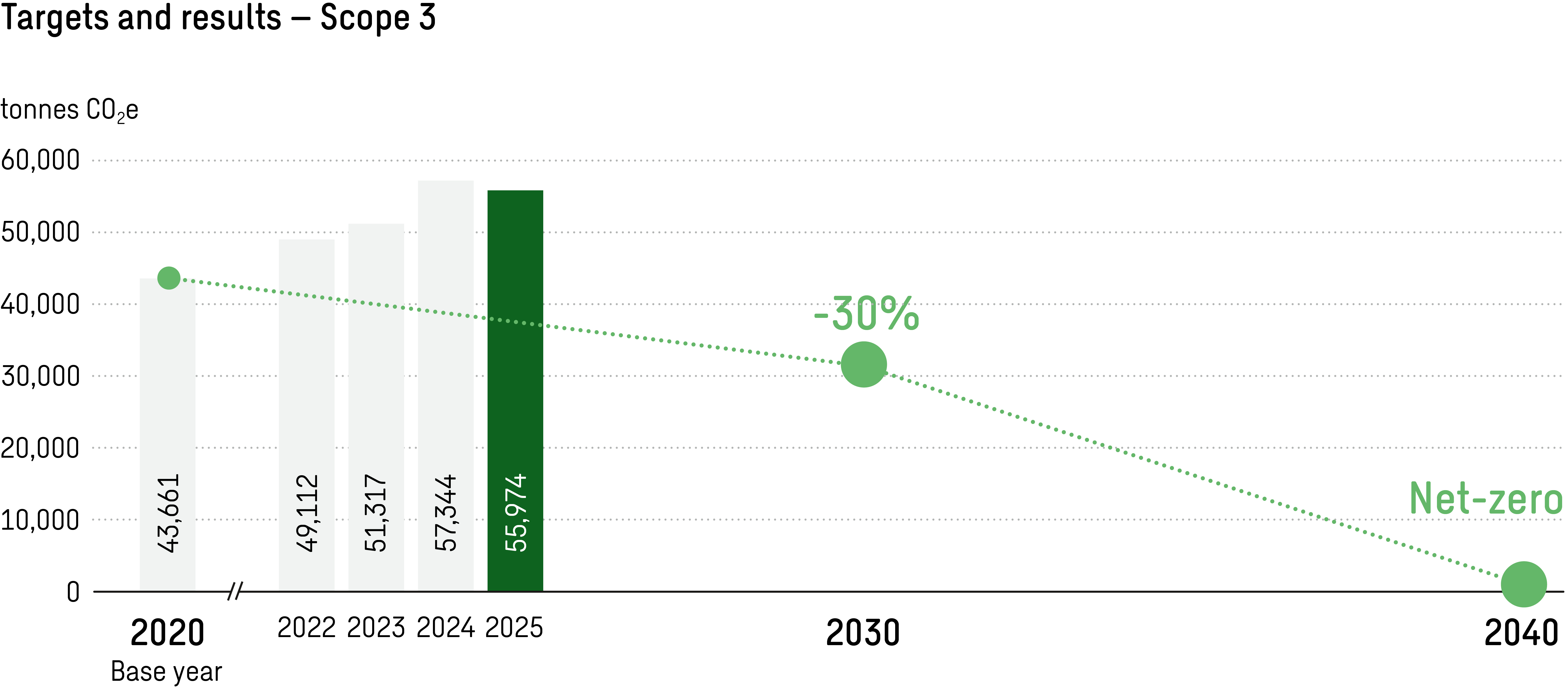
Sweco commits to reduce absolute Scope 3 GHG emissions from purchased goods and services, capital goods, fuel- and energy-related activities, waste management, business travel and employee commuting by 30 per cent by 2030.
Base year
2020
Sweco’s emissions reductions are measured against 2020 levels.

“We are pleased to have our near-term climate targets validated by SBTi. This is a testimony to Sweco’s climate action ambitions.” – Åsa Bergman, President and CEO, Sweco

Net-zero by 2040
Sweco’s climate target is to achieve net-zero by 2040 and to halve the company’s greenhouse gas emissions by 2030 from base year 2020 levels. The target will be achieved by reducing absolute emissions from Sweco’s own operations by at least 90 per cent by 2040, as compared with 2020 levels. The remaining emissions reductions, down to zero, will be achieved through supplemental permanent measures such as carbon sinks or fossil-origin carbon capture and storage. Sweco’s decarbonisation strategy prioritises emissions reductions as far as possible and the company has not yet applied greenhouse gas removals.
Five key actions to reduce emissions
- Fossil-free energy in offices
- Transition of the vehicle fleet
- Decarbonisation of the supply chain
- Sustainable mobility
- Circularity and resource efficiency
Climate Transition Plan 2030
Sweco’s approach to accelerating the transition is described in the Climate Transition Plan, which is anchored in Sweco’s overall strategy.
2025 in brief
- Sweco’s climate footprint in 2025 amounted to 64,478 tonnes CO2e, a decrease of 8 per cent compared with the previous year and 1 per cent compared with the base year 2020.
- Scope 1 emissions decreased 24 per cent compared with 2024, and Scope 2 emissions decreased 49 per cent. Scope 1 and 2 emissions have decreased a total of 13,220 tonnes CO2e since 2020, corresponding to a reduction of 61 per cent.
- Scope 3 emissions decreased 3 per cent compared with 2024 and account for 87 per cent of total emissions. Since 2020, Scope 3 emissions have increased 12,312 tonnes CO2e, corresponding to an increase of 28 per cent.
- In 2025, the proportion of renewable energy in Sweco’s offices increased by 6 percentage unit to 44 per cent (38) compared with the previous year.
- The share of electric vehicles increased to 68 per cent (53) of Sweco’s vehicle fleet.
Sweco and the EU taxonomy
Group greenhouse gas emissions, tonnes CO2e
| Scope | 2025 | 2024 | Base year 2020 | Share of total emissions 2024, % | Change, 2025 vs. 2024, % | Change, 2025 vs. 2020, % |
|---|---|---|---|---|---|---|
| Scope 1 | 5,902 | 7,776 | 11,615 | 9 | -24 | -49 |
| Scope 2 | 2,602 | 5,004 | 10,109 | 4 | -48 | -74 |
| Scope 3 | 55,974 | 57,344 | 43,661 | 87 | -2 | +28 |
| Total | 64,478 | 70,123 | 65,386 | 100 | -8 | -1 |
About the GHG Protocol
The GHG Protocol has defined a global standardised framework to measure and manage greenhouse gas (GHG) emisssions within three scopes. Scope 1 and 2 emissions are mandatory part of reporting and relate to direct emissions from sources that are owned or controlled by Sweco, such as company cars, and indirect emissions from the generation of purchased electricity, heating and cooling consumed by Sweco. Scope 3 covers other material indirect emissions orginating from Sweco’s upstream value chain, e.g. purchased goods and services, capital goods, energy related activities not included in Scope 1 and 2, waste generated in offices, business travel and employee commuting.


Sustainability Report
Sustainability forms an integral part of Sweco’s business and strategy.

Transforming society together with our employees
We attach great importance to being an attractive employer for both current and future talent and leaders.

Business ethics
Sweco takes responsibility for our projects and the way we conduct our business.

