The healthcare sector is one area that is an almost constant state of change, growth and development. Technological advances and new requirements mean that the need for optimised spaces in hospitals that offer care and health for patients and staff is more crucial than ever. As municipalities identify measures to ensure a sustainable future, energy efficiency in hospitals has also come under examination.
“Many of Europe’s hospitals were built in the 1960s and 1970s. At Sweco, we have experts that are working on client projects to make these buildings energy efficient to meet sustainability goals, since it’s often more sustainable to refurbish rather than to demolish and build new,” Fredrik Karlsson, Team Leader, Sustainable Buildings, Sweco explains.
One part of the hospital landscape which is particularly high energy intensive is operating rooms, which are energy intense spaces due to the needs for heating, ventilation, air conditioning (HVAC) as well as for lighting, patient monitoring equipment and due to the long hours that operating rooms are used.
“Any way that we can find to reduce energy costs and energy needs is very important in the healthcare sector. Our approach is that one shouldn’t use more energy than is necessary in healthcare, even if healthcare today has different demands. Many modern machines are larger, and there is a need for other rooms than were once considered standard in healthcare previously. At Sweco, we can use our broad expertise to find creative and sustainable energy management solutions,” Fredrik Karlsson says.
“When Sweco architects, and energy management consultants collaborate with the client in the initial design phase, there are so many additional ways to ensure that energy efficiency targets can be met or even surpassed,” he explains.
Discussing things such as window size, the number of windows to be used and their placement in the building, can have an impact on energy efficiency and it’s much easier to discuss these things while looking at the proposed site, and using energy simulations for the design of the technical system in the hospital energy simulation programmes, and to understand where the energy savings measures are best suited to be implemented when designing the structure. – Fredrik Karlsson, Team Leader Sustainable Buildings at Sweco
Creating sustainable solutions for energy saving in operating rooms
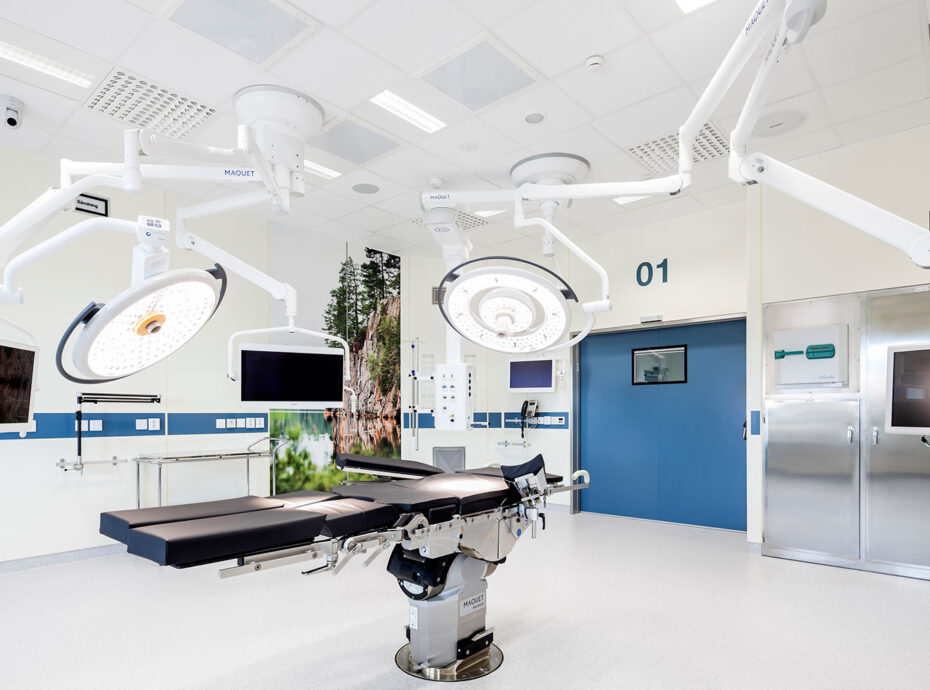
One example of how Sweco has worked together with healthcare clients to find energy saving solutions is at Centralsjukhuset Karlstad, (the Central Hospital in Karlstad). The hospital, located in southwest-central Sweden is home to Sweden’s most modern operating theatre and includes a 28,000 square metre new building and the conversion of 7,000 square metres. The client, the County Council of Värmland commissioned the building of the operating room of the future, with the patient in focus.
The new operating room was a green project with a focus on energy and material choices. Energy use in the new operating room is low compared to other hospitals, and energy simulations were used to determine values and to find solutions that gave low energy consumption and a good indoor climate.
In addition, the operating theatre has been certified according to the international environmental certification system LEED.
It is the first building in Sweden to be certified according to the new LEED Healthcare classifications and was assessed in areas such as choice of materials, indoor climate, energy use, water consumption and location.
In addition to the project’s environmental plan, there were three main areas that guided the environmental work: LEED, SundaHus and energy management.
LEED certification-how it works and why it’s important
LEED is a third-party green building certification programme. LEED certification offers the reliability and a third-party validation of environmentally responsible construction practices. It is globally recognised as a standard for the design, construction and operation of high-performance green buildings and neighbourhoods.
LEED provides a framework for healthy, efficient, carbon and cost-saving green buildings.
LEED certification is a globally recognized symbol of sustainability achievement, and it is backed by an entire industry of committed organisations and individuals dedicated to determining the way forward for sustainable transformation.
Buildings that meet or exceed LEED requirements cost less to maintain and produce less waste.
SundaHus -materials selection database
Building materials used in the hospital project were selected from the Swedish SundaHus database, which contains information on environmentally rated building products. For the surgical building, products were chosen from the two highest classifications. Each selected product was entered into the database and there was an overview of the products used. In this way the client was able to have an exceptionally high number of documented materials.
By using systems that rate construction products, it is hoped that new demands will be placed on suppliers which will ultimately help to develop the industry through the checking and evaluating of the products used.
Energy management and climate smart measures
The latest technology in energy solutions and climate-smart measures were used. One example is air flows, which are dimensioned according to the latest research on cleanliness for operating rooms. Rotary heat exchangers with an air handling unit for each operating theatre have been used, which minimises the risk of infection and will have lower running costs over time.
Seventy new energy wells were drilled in the rock for geothermal energy, reducing the amount of energy purchased.
Finding a balance between energy management and sustainable healthcare to build an energy efficient hospital is very important. With better understanding of healthcare processes, we can find ways to use less energy at the workplace, for instance by using lighting that is dynamic and only used when necessary, or by finding ways to recover heat from MRI cameras and using the recovered heat for heating the building. This is only the beginning, Sweco experts are looking at sustainable solutions and there will be many new and exciting developments to come in the healthcare sector. – Fredrik Karlsson, Team Leader Sustainable Buildings at Sweco
Let us connect
Please fill out this form and we will ensure that you get in contact with the right Sweco expert.
Manage Cookie Consent
We and our partners use cookies and similar technologies to operate our website, analyse traffic, personalise content, and serve and measure personalised ads. You can accept all cookies, reject non-essential cookies, or manage your preferences below. For more info, please visit our Cookie Policy
Functional
Always active
The technical storage or access is strictly necessary for the legitimate purpose of enabling the use of a specific service explicitly requested by the subscriber or user, or for the sole purpose of carrying out the transmission of a communication over an electronic communications network.
Preferences
The technical storage or access is necessary for the legitimate purpose of storing preferences that are not requested by the subscriber or user.
Statistics
The technical storage or access that is used exclusively for statistical purposes.The technical storage or access that is used exclusively for anonymous statistical purposes. Without a subpoena, voluntary compliance on the part of your Internet Service Provider, or additional records from a third party, information stored or retrieved for this purpose alone cannot usually be used to identify you.
Marketing
The technical storage or access is required to create user profiles to send advertising, or to track the user on a website or across several websites for similar marketing purposes.