Climate Adaptation and cloudburst management in a historic urban environment
Assignment
Create a facility for managing and temporarily storing large volumes of cloudburst water, with a design that harmonises with the surrounding environment and adds new value.
Client
Transport Department, City of Stockholm
Location
Östermalmsgatan/Birger Jarlsgatan
Areas of expertise
Landscape architecture, stormwater management, water and wastewater engineering, utility coordination, structural engineering, geotechnics, soil and land environment, cost estimation
Storage capacity
150,000 litres
Cloudburst management integrated into a historic urban environment
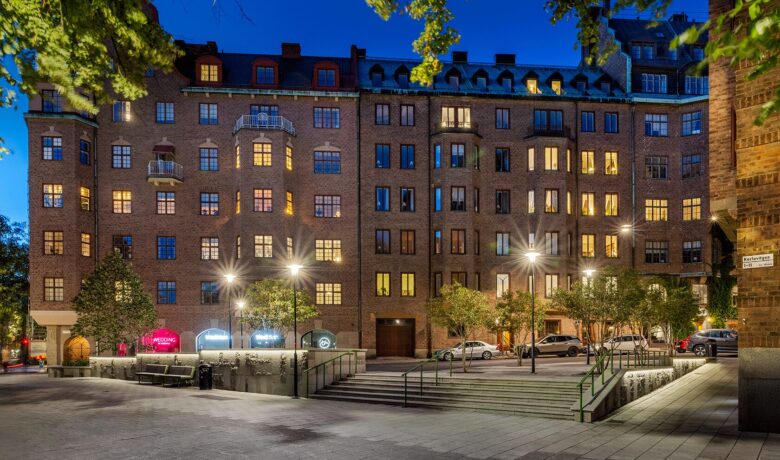
In Östermalm, Stockholm, Sweco has designed and engineered a new small square with integrated cloudburst management. Through underground storage facilities, planting beds and well-considered stormwater solutions, the site can temporarily store up to 150,000 litres of water.
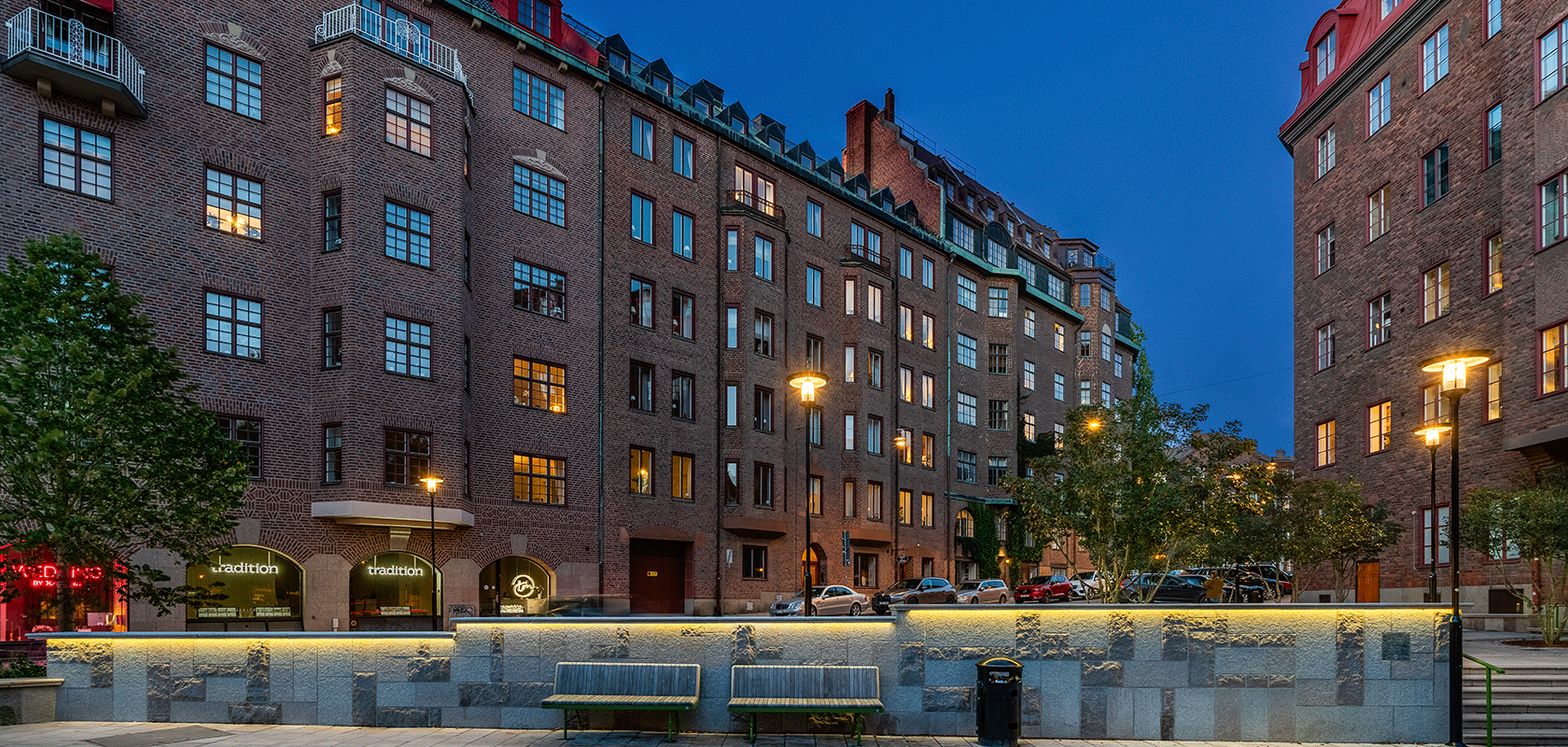
At the same time, the area at the intersection of Östermalmsgatan and Birger Jarlsgatan has been redesigned to complement the culturally and historically valuable Lärkstaden district.
This is an excellent example of what is possible when landscape architecture and engineering are developed together from the outset.– Staffan Sundström, Project Manager and Landscape Architect LAR/MSA, Sweco
Climate adaptation as part of urban development
Like many other cities, Stockholm is facing a changing climate, with increased risks of intense rainfall and flooding. A risk and vulnerability assessment, produced by Sweco on behalf of the City of Stockholm in 2018, identified areas where cloudbursts could have serious consequences for people, buildings and critical infrastructure. An action plan was subsequently developed, identifying six locations in Östermalm as potential pilot projects for improved cloudburst management.
By temporarily storing water high up in the catchment area, the pressure on areas further downstream in the system is reduced. This, in turn, reduces the risk of damage to buildings and infrastructure during heavy rainfall. Östermalmsgatan was selected as the first site to be addressed.
150.000
litres of rainwater can be temporarily stored
7
new trees have been planted
10
different drains have been used
Cloudburst management below ground and in planting beds
One of the key challenges in the project was to create a large storage capacity within a limited area in an already densely built-up urban environment. The site is also located in an area with shallow groundwater and existing piping that could not be affected.
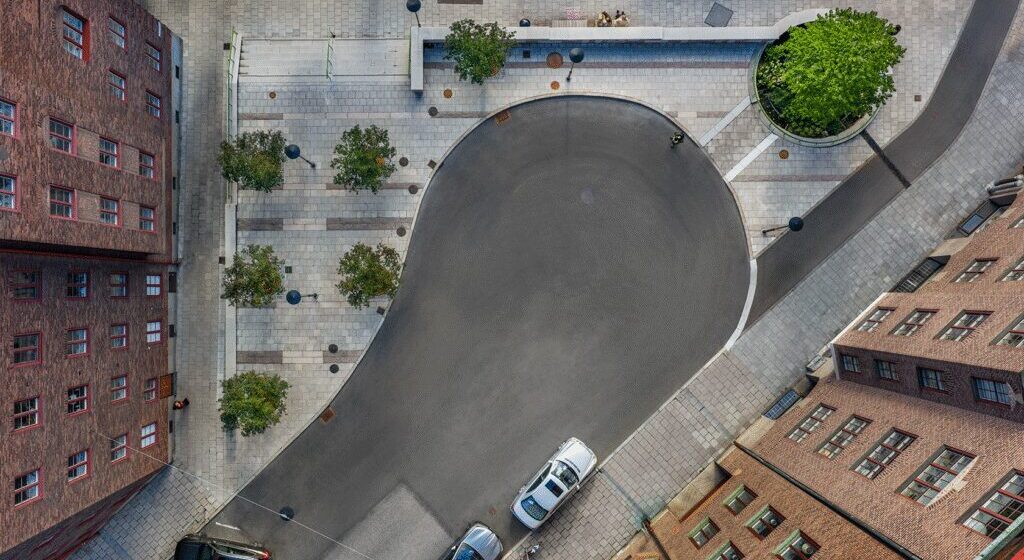
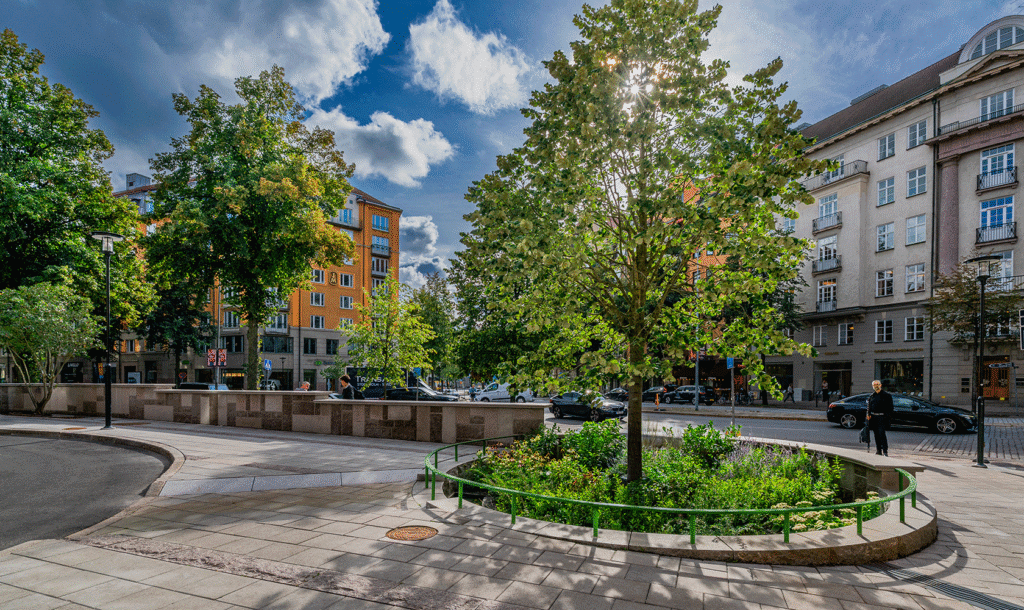
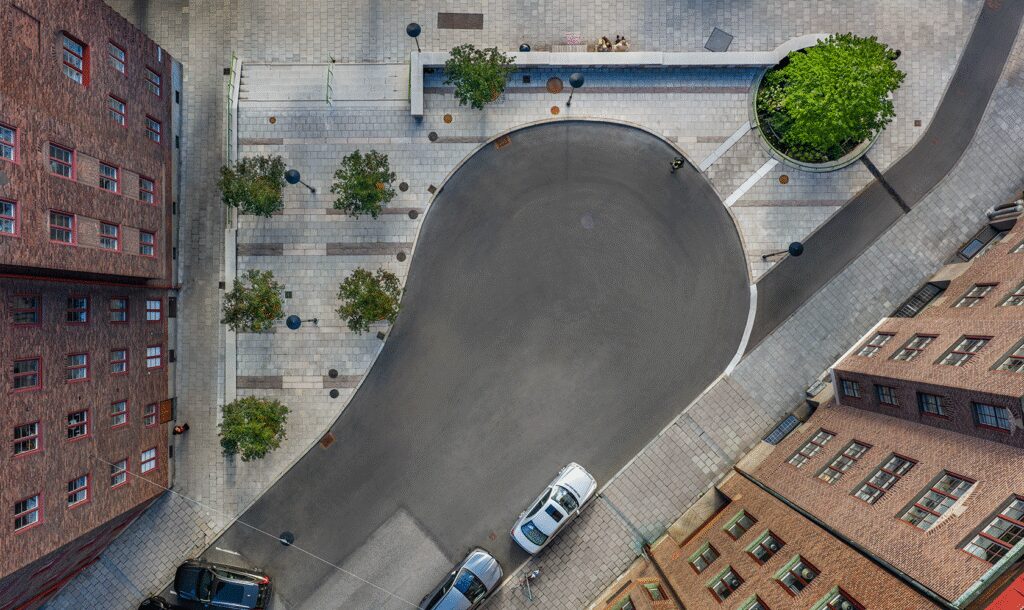
The solution consists mainly of two new planting beds. One is a large structural soil system in the central part of the square, while the other is an open rain garden in the western corner of the square. The planting beds are essential for the greenery and also form part of the site’s system for managing stormwater and cloudbursts.
The structural soil in the square receives water from four stormwater drains along the southern side of the turning area. The drains are connected to underground crate storage systems. During rainfall, the water is first directed into the storage systems, where it can be temporarily retained. It then infiltrates into the planting bed and is taken up by the tree roots or detained before being discharged into the public stormwater system.
The open rain garden in the western corner of the square receives water at surface level. A broad gutter conveys water from the low point of the turning area to the planting bed, while additional water comes from a stormwater channel in the adjacent cycle lane. Sediment traps at the inlets capture gravel and other material. During lighter rainfall, water can infiltrate through the sediment traps. During heavier rainfall, the water flows over into the planting bed, where it is temporarily stored.
The two planting beds are also connected by a pipe. If the rain garden becomes full, excess water is conveyed to the underground storage facility. During very high flows, the water is ultimately discharged into the stormwater pipe system. In this way, open and concealed solutions are combined to create as large a storage volume as possible. In total, the facility can temporarily store approximately 150,000 litres of stormwater.
Östermalmsgatan is an exciting pilot project where we can test new solutions for managing cloudbursts in a dense urban environment. The project has given us the opportunity to test new ways of constructing and managing cloudburst water, while also creating a more attractive, welcoming and vibrant place in the city.
– Kristina Olsson, Project Manager, Traffic Office, City of Stockholm
Landscape architecture combining function and design
The project demonstrates how landscape architecture can contribute both to technical climate adaptation and to a more attractive urban environment. The new space has been designed with consideration of Lärkstaden’s unique architecture and cultural heritage values and has been developed in dialogue with the Transport Department, the Stockholm City Museum and the Stockholm Beauty Council.
A new wall creates a difference in level between Birger Jarlsgatan and it also frames the new square. The raised ground creates space for the underground storage facility. The wall is clad in two different types of granite, with different surface finishes, reflecting the variation found in the plinths of the surrounding buildings.
The site also includes new trees, plantings, specially designed planting barriers and handrails, as well as seating furniture. The green colour of the barriers relates to the site’s blue-green function and to the verdigris-green roofs in the area.
A blue-green space with multiple functions
In addition to managing stormwater and cloudbursts, the site contributes to new ecological and social values. The vegetation provides shade, helps lower temperatures and may, over time, strengthen biodiversity in the city.
As part of the project, a special cover for the stormwater channels was developed. The cover has a unique design and is also intended for use at other future cloudburst management sites operated by the City of Stockholm. In this way, the technical infrastructure becomes a visible part of the urban environment and can help draw attention to how the city works with water management and climate adaptation.
By combining landscape architecture with specialist expertise in stormwater and cloudburst management, it has been possible to integrate a technically advanced solution into the existing urban environment in a harmonious way.
Did you know that…
There are many different types of stormwater solutions, including rain gardens, structural soil systems, ponds, swales and green roofs.
Stormwater is not only a problem, but also a resource. With the right solutions, rainwater can contribute to increased greenery while being treated and temporarily stored before reaching lakes and waterways.
The City of Stockholm has requirements stating that stormwater from new construction and major redevelopment projects must be temporarily stored and treated in sustainable stormwater management systems.
Manage Cookie Consent
We and our partners use cookies and similar technologies to operate our website, analyse traffic, personalise content, and serve and measure personalised ads. You can accept all cookies, reject non-essential cookies, or manage your preferences below. For more info, please visit our Cookie Policy
Functional
Always active
The technical storage or access is strictly necessary for the legitimate purpose of enabling the use of a specific service explicitly requested by the subscriber or user, or for the sole purpose of carrying out the transmission of a communication over an electronic communications network.
Preferences
The technical storage or access is necessary for the legitimate purpose of storing preferences that are not requested by the subscriber or user.
Statistics
The technical storage or access that is used exclusively for statistical purposes.The technical storage or access that is used exclusively for anonymous statistical purposes. Without a subpoena, voluntary compliance on the part of your Internet Service Provider, or additional records from a third party, information stored or retrieved for this purpose alone cannot usually be used to identify you.
Marketing
The technical storage or access is required to create user profiles to send advertising, or to track the user on a website or across several websites for similar marketing purposes.