
Antarctic Infrastructure Modernisation Programme
Antarctic Infrastructure Improvement Programme
BAM contracted to British Antarctic Survey
Marine design, building design, architecture, carbon management and sustainability goals, strategy development, environmental engineering, geotechnical, cold climate design, fire, digital delivery, collaborative work planning and construction planning support..
Rothera, South Georgia, South Orkney Islands, UK Antarctic Territories



Polar station modernisation project
The Antarctic Infrastructure Modernisation Programme (AIMP) is transforming how British Antarctic Survey (BAS) enables and supports frontier science. Commissioned by UKRI/NERC (UK Research and Innovation/National Environment Research Council), the multi-year investment aims to modernise research facilities in the Polar Regions to ensure that the UK remains at the forefront of climate, biodiversity and ocean research in Antarctica. The programme is delivered in partnership with BAS, BAM, Ramboll and Sweco. The collaborative approach undertaken by the partners and their extended supply chains is critical to the success of delivering remarkable results in this uniquely challenging environment.
Involved in the project since 2017, Sweco’s consultants are providing a wide range of expertise. Not only are they learning about the challenges of designing in such a harsh environment, but for those who have the opportunity to work on site, they must make an 11,000 kilometre voyage, by ship, to do so. Once there, the team then has up to six months to complete the required works during the Antarctic summer months (December to May).
The modernisation work has included the deconstruction of the old wharf at Rothera Research Station and, the construction of a larger wharf to accommodate BAS’s new polar research vessel, the RRS Sir David Attenborough. In May 2021, the new wharf achieved the first CEEQUAL award in Antarctica, gaining an Excellent rating. The measures that enabled the project to score so highly included a change in the wharf design to reduce the need for milling of the seabed to protect benthic habitats, as well as the project’s strict biosecurity practices to prevent the introduction and spread of non-native species in Antarctica.
Another key component of Phase 1 of the AIMP project is the construction of a new science and operations building, the Discovery Building, which will replace more than half a dozen buildings that are reaching the end of their lives. With the pre-cast concrete foundations, ground floor slab, rock anchors and stub columns, as well as drainage and the perimeter wall completed in 2021, work began in December 2022, on making the 4,500-m2 Discovery Building weather-resistant. The sustainable features of the Discovery Building include a thermally-efficient envelope to minimise energy use, heat recovery generators and photovoltaic solar panels. To minimise snow accumulation around the entire perimeter of the building, it also features a slight pitched roof and wind deflector, the largest of its kind in Antarctica. When it opens in 2025, the building will contain preparation areas for field expeditions, offices, a medical centre, recreational spaces (music room and climbing wall) and science workshops.
Work in the 2022-2023 construction season also includes restoring Rothera’s 32-year-old runway to its original length and the installation of new energy-efficient runway lighting to maintain safe flying operations into Rothera, a critical access point for field science operations.
We are also playing a key role in developing the Rothera Renewable Energy Project which will help achieve zero emissions for the research station’s operations. In the coming years, core renewable energy systems will be identified and installed alongside core energy efficiency measures. Feasibility studies researching innovative new technologies will also be undertaken. This will provide a robust and resilient energy strategy that will meet decarbonisation ambitions, deliver current energy demands and futureproof Rothera Research Station beyond 2030.
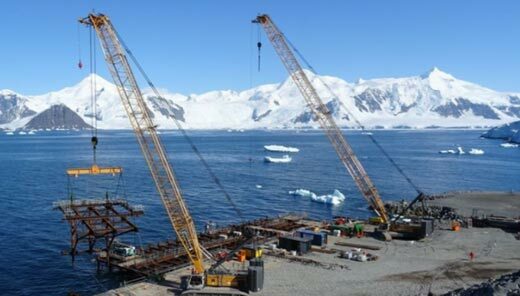
Demolition and reconstruction of the wharf are necessary in order to accommodate the polar research vessel, the RRS Sir David Attenborough, which will carry out cutting-edge research into polar science.

Expansion of the wharf was required to accommodate the new BAS ship RRS Sir David Attenborough. The design was undertaken following non-intrusive SI following thorough risk appraisal. Three mooring points maximise the position of the vessel for moving cargo on and off ships.

This important bird and seal breeding location in South Georgia delivers frontier science research.

The Discovery building is the most significant project of the Phase 1 projects delivered by BAM/Sweco team. Key aspects of the building are thermal performance, capture and reuse of thermal energy from electricity generation and recirculation of heat. A novel wind deflector device is also included to reduce the effort required to manage snow in operation.
Multi-year collaborative project partnership
The AIMP partnership showcases how, even in the most extreme circumstances, commitment to genuine collaborative partnerships can deliver optimal performance in project delivery. The collaborative ethos of the partnership has led to many benefits, including effective programme decisions, a joined-up approach to risk management and a team of committed individuals who share in BAS’s vision.
Using a ‘right-the-first-time-approach’ with no margin for errors, delays or defects in the final product, maintaining and managing the budget, working around complex logistics, testing and trialling design and construction, as well as planning ahead and incorporating future requirements into the programme are some of the areas where Sweco has added value.
