A technology and science playing field for students and teachers
H.C. Ørsted Senior High School
The new technical senior high school H.C. Ørsted Gymnasium, is named after the Danish scientist who discovered electromagnetism and caters for approximately 750 students. The building manifests itself in a number of areas, paying homage to science and to Hans Christian Ørsted.
Facts about the project
Client
TEC – Technical Education Copenhagen
Place
Kongens Lyngby, Denmark
Contractor
CC Contractors, Anker Hansen, WSP, Thing Brandt Landskab
Status
Completed
Size
8.800 sqm
Photographer
Kristian Holm
Inspired by electromagnetic coils
The main architectural feature of school, situated northwest of the Danish capital Copenhagen, is a stack of large, rounded shapes, which make visual reference to electromagnetic coils. The coils each contain classrooms, labs and meeting rooms. They form the interior structure of the building, while also extending into the facade and merging together, giving a common thread to the appearance of the facade.
Sweco Architects’ aim has been to create a building that becomes an active and integral part of the teaching and is aligned with the school’s ambitions. Our focus has been on zoning and on opportunities for working across disciplines, so that changes in pedagogical practice are supported by and integrated directly into the architecture. The result is a learning space that inspires and arouses curiosity.
The aula and auditorium make up the school’s central focal point.
The coils are the school’s academic focal points, containing classrooms and meeting rooms.
A continuous polished concrete floor binds the coils together and leads out to the surrounding outdoor areas.
The school’s circular infrastructure orbits the two stairwells and meets in the heart of the school.
Outdoor terraces form a natural extension to interior learning spaces.
The coils are also evident in the facade, linking the interior and exterior spatialities of the building into a single unit.
Two sides of the same building
The new building has different looks, depending on the direction you approach it from, rising like a landmark from one side, but scaled down and more inviting from another. To the east, the coils are used to cascade down the building. To the west they are used to create a wall intended to arouse the curiosity of passersby. Curiosity is a consistent theme for the building overall.


Unique facade solution
The facade is the building’s unifying architectural element. A specially developed system using vertical aluminum battens gives the building its unique look. The various profiles and aluminum shades of the facade surround the entire building and noise wall, so these have a homogeneous architectural expression that constantly changes character.
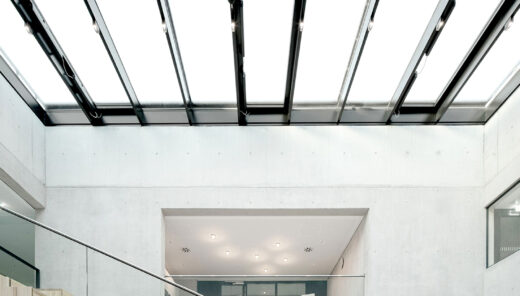
At the heart of the building is a distinctive, three-storey aula, which changes character throughout the day as the daylight is refracted at different angles by the batten surface. It is also intended as a place where students can meet for social events.
The Coils
The spatial organisation of the building is defined by the coils. There are classrooms, meeting rooms and stairwells, which communicate the transition between the inner and outer learning spaces. To create an exciting and varied teaching environment, the building must offer varying spaces for students to explore. For example, the coils feature different kinds of fixtures, based on how they are used.
While the labs have been assigned to the coils, the common areas and classrooms have been grouped in the spaces between them. The result is an open and flexible floor plan, where classrooms can be easily transformed and incorporated into the common areas.
Overall, the building provides a space for scientists of the future to flourish.